Secured Events - IoT Connected Bracelet
CONTEXT & CHALLENGES
Securing event access without burdening the experience.
Since 2019, Rezoloco has supported CHANEL Watch & Fine Jewelry in securing its commercial events through the Secured Events ecosystem: a guest management back-office and a mobile access control application using QR codes.
The system worked perfectly for guests, who received their QR code by email. But a blind spot remained: external teams - caterers, technicians, service providers - who work on-site without necessarily having a suitable smartphone. A reliable way to identify them was needed, without disrupting the security protocol already in place or complicating on-site organization.
The challenge: designing a portable physical device capable of displaying a unique QR code for each worker, readable by the existing application and autonomous enough to last the entire duration of an event.
- Event security
- IoT
- Access control
- NFC
- e-ink
OBJECTIVES
A smart badge: autonomous and invisible in use.
The specifications posed strong constraints. The device had to integrate with the Secured Events ecosystem without questioning the existing architecture - Next.js back-office, React Native application, QR code validation logic. It also had to operate without recharging for several days, withstand event conditions (frequent handling, prolonged wear) and remain compact enough to be worn on the wrist.
In practical terms, three objectives guided the design: ensuring maximum energy autonomy through e-ink technology, which only consumes power when refreshing the screen; ensuring physical robustness suited to field use, with reliable connections and a reduced form factor; and preserving ease of use for security teams, who needed to assign a badge in just a few seconds.
- Energy autonomy
- Wearable
- Ecosystem compatibility
- Field robustness
SOLUTION
From wired prototype to contactless badge: two iterations to converge on the right form factor.
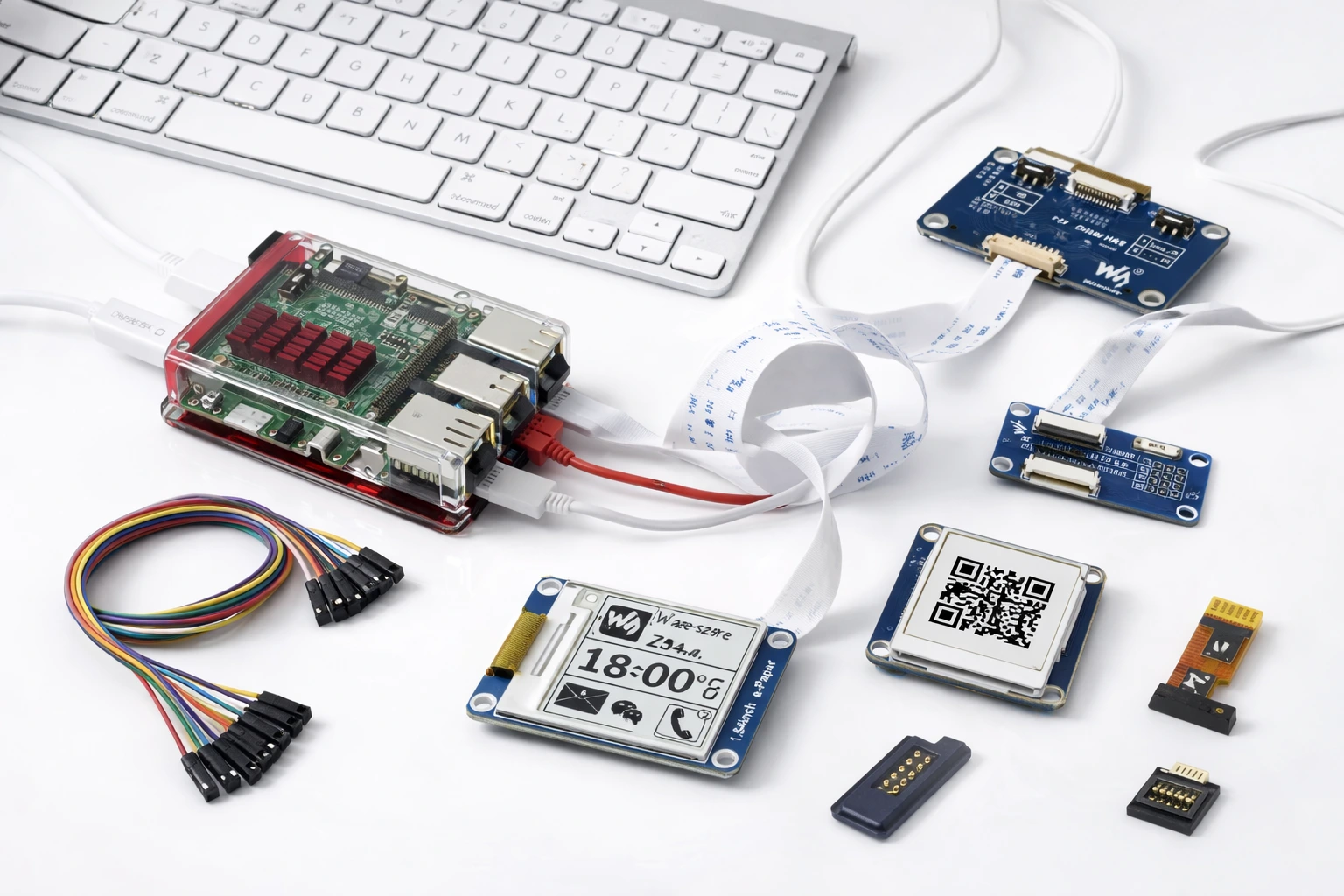
The first approach involved developing an embedded application on Raspberry Pi, containerized with Docker, to load the participant list, select a worker and generate their QR code on the fly. The image was then transmitted to a small e-ink screen capable of retaining it for several days without power. The first prototype, equipped with a 2.13-inch screen, validated the principle: the image held, and the module could be disconnected and reconnected without loss.
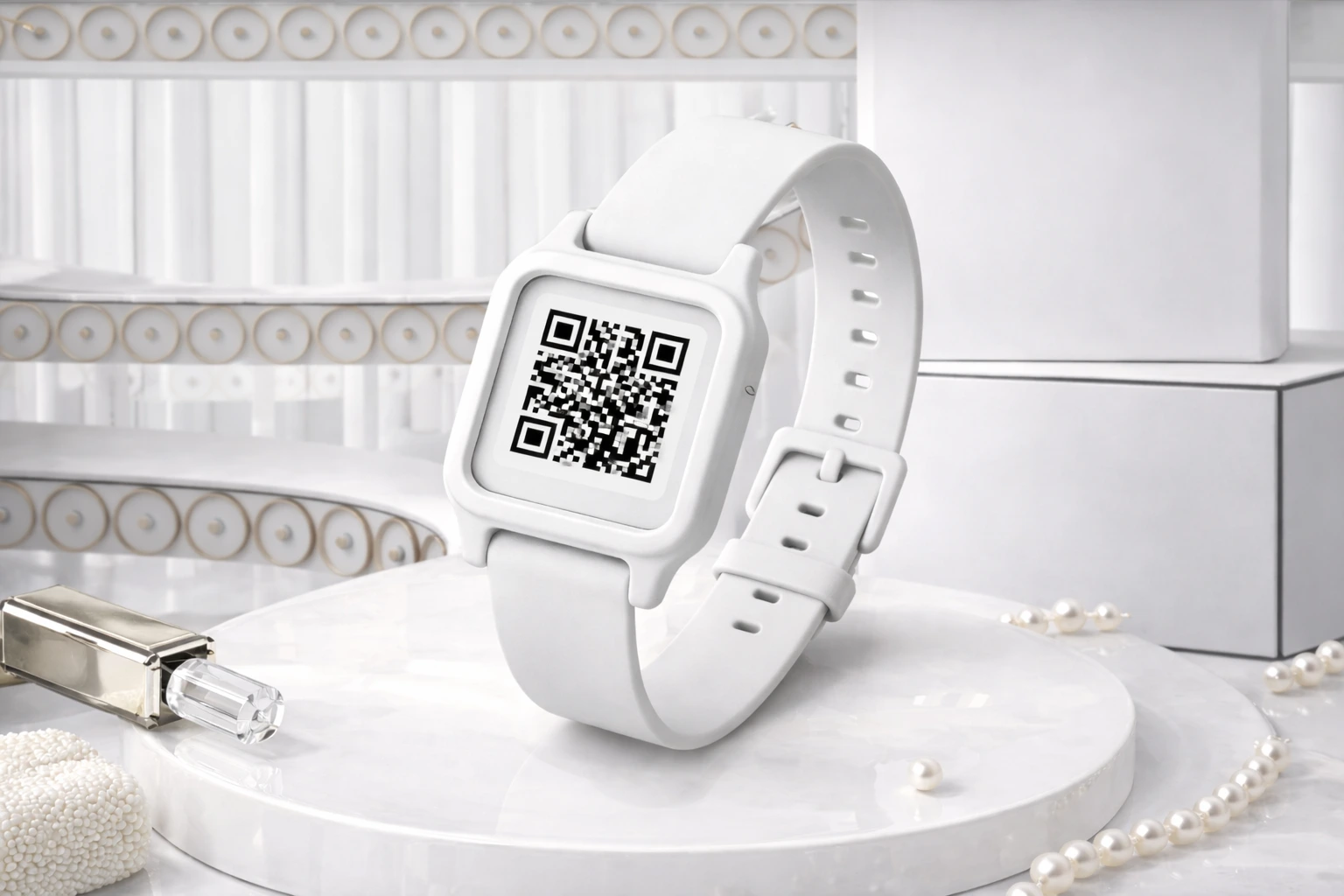
But the form factor remained too bulky to wear on the wrist. The team therefore optimized the device by switching to a 1.54-inch screen with an integrated interface, replacing fragile connectors with a magnetic quick-disconnect system, and reducing the whole assembly to a 60 × 33 mm module - a size compatible with a watch-style bracelet casing.
The second iteration explored a radically different path: removing the Raspberry Pi from the portable device entirely. In this approach, the Secured Events mobile application itself, after validating a worker's access, generates a new QR code and transmits it directly to a passive e-ink screen via NFC. The badge no longer needs a battery or wired connection - it is powered by the smartphone's NFC field only at the moment of writing.
This two-stage evolution made it possible to quickly test the concept with a functional prototype, then converge on a lighter, more cost-effective solution that is simpler to deploy at scale.
- Raspberry Pi
- Docker
- e-ink
- React Native
- NFC
- Rapid prototyping
Ready to take action?
Let's talk about your project and build together the solution that will make the difference.
Start the conversation