AI for UX
How AI is transforming the way we design interfaces.
THE SHIFT
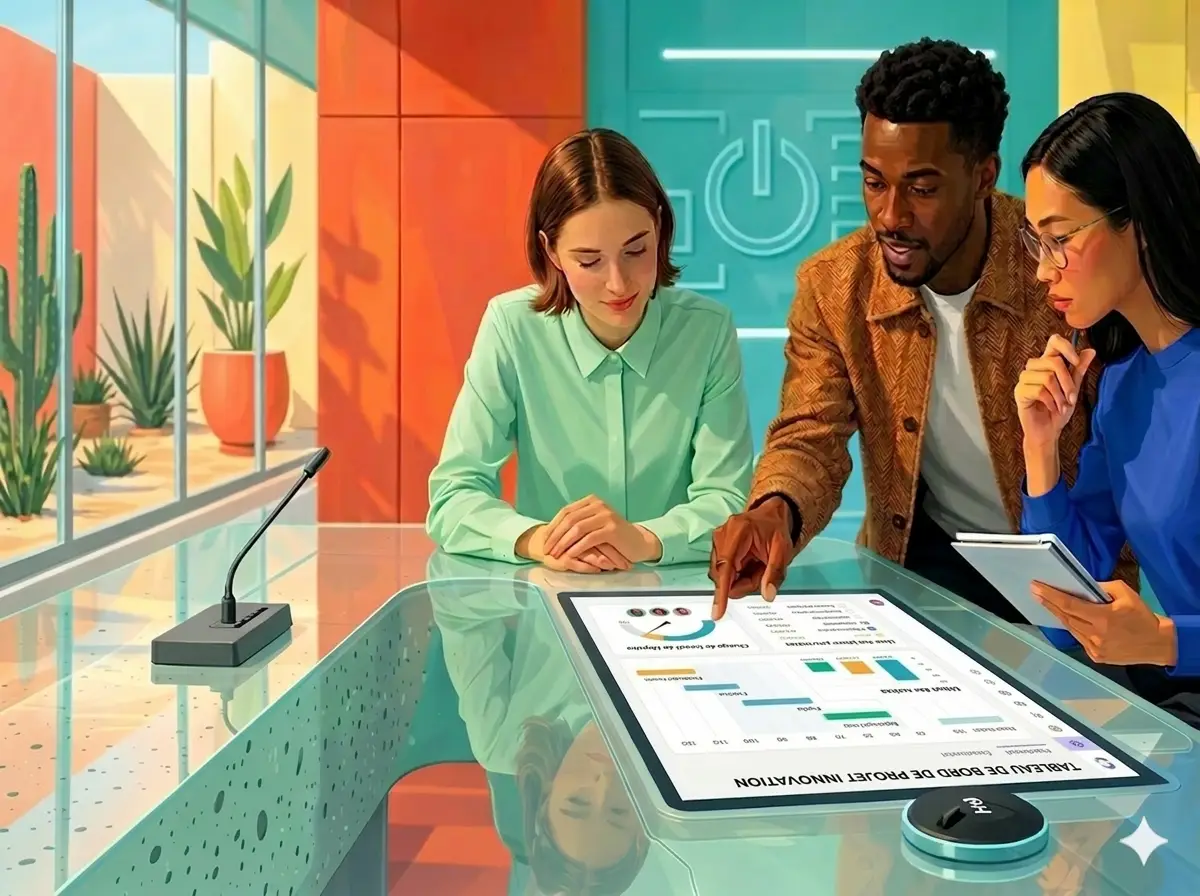
AI doesn't replace the designer. It changes what they focus on.
For years, designing an interface was 80% production and 20% thinking. Declining screens, adjusting pixels, documenting specs. AI inverts this equation. Repetitive tasks get automated, and the designer can finally spend most of their time where they truly create value: understanding users, asking the right questions, making the right trade-offs.
This isn't a fantasy. It's already happening. Variant generation, layout suggestions, automated journey analysis: the tools exist, and they improve every month. The question is no longer "will AI change UX" - it's "are you ready".
USER RESEARCH
Understand your users in days, not months.
Traditional UX research takes time. Recruiting testers, conducting interviews, synthesizing hours of verbatim. AI doesn't eliminate these steps - it accelerates them. Semantic analysis of customer feedback, automatic behavior clustering, pattern detection in analytics data. What took three weeks now takes three days.
But the real gain isn't speed. It's depth. AI can cross-reference thousands of feedbacks, spot weak signals a human would have missed, and reveal needs nobody had articulated. The designer keeps control over interpretation - but works with infinitely richer material.
PROTOTYPING
From idea to screen in minutes.
Sketching a wireframe, generating ten variants of a component, turning a paper sketch into an interactive mockup: AI compresses the creative production phase. We're not talking about letting a machine design for us. We're talking about exploring more paths, faster, before converging on the right one.
It's a pace change that transforms how we collaborate. When producing a prototype takes ten minutes instead of two days, you can test an idea in a meeting instead of debating it in a vacuum. Decisions are made on concrete material, not assumptions. And bad directions get killed early - before they become expensive.
PERSONALIZATION
Interfaces that adapt to each user. For real.
Until now, personalizing an interface meant at best three personas and a few conditional display rules. AI makes granular personalization possible: adapting content hierarchy to usage context, adjusting information density to expertise level, suggesting shortcuts based on actual habits.
This isn't gimmick personalization. It's UX that learns. A dashboard that reorganizes its widgets based on your current priorities. A form that pre-fills intelligently. Navigation that shortens your recurring journeys. The interface no longer imposes itself - it steps aside in favor of the goal.
TESTING & ITERATION
Test at scale, learn faster.
A classic A/B test is one hypothesis, two variants, and several weeks of waiting for a statistically significant result. AI changes the game. Real-time multivariate testing, predictive heatmaps, automatic friction point analysis. We iterate faster because we understand faster what's not working.
And then there's qualitative analysis. AI can review hundreds of user sessions, identify moments of hesitation, recurring drop-offs, gestures that betray confusion. The designer no longer looks at abstract metrics - they see concrete behaviors, at a scale no team could handle manually.
THE AUGMENTED DESIGNER
The human stays at the center. But goes further.
AI doesn't design better interfaces. It gives the designer the means to do so. Less time on mechanical production, more time on strategy, empathy, creation. The challenge isn't replacing human judgment - it's giving it a reach it never had before.
At Rezoloco, we use AI as a relevance multiplier. Not to go faster at any cost, but to be more accurate. Because a truly well-designed interface isn't the one with the most features or the most spectacular design. It's the one the user doesn't even notice - because it does exactly what they expect, when they expect it.
Want a more responsible web?
Let's design sober, performant and sustainable digital solutions together.
Start the conversation